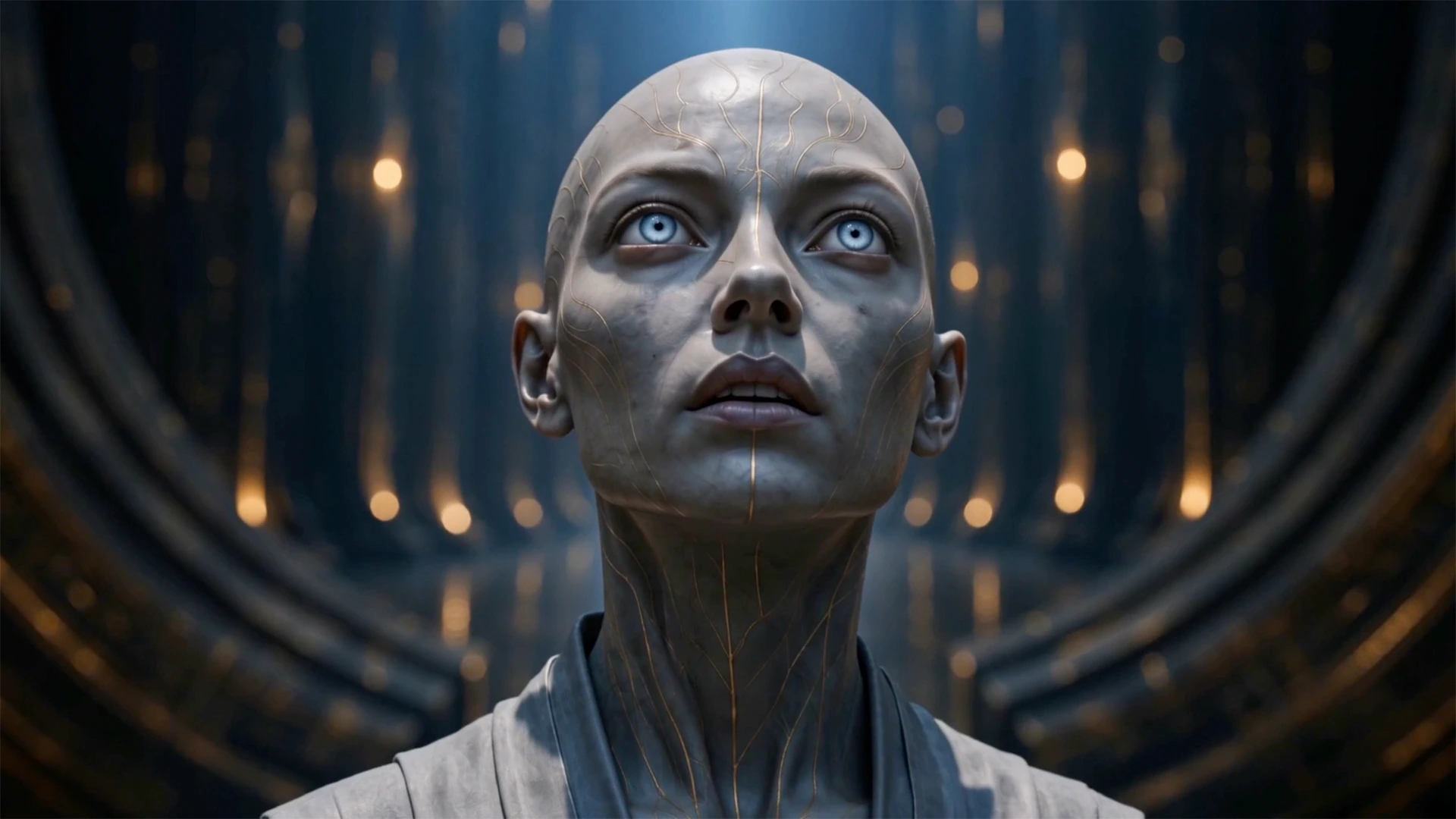
Our beta creator Khurram Alavi goes under the hood of IONA, his sci-fi dark-fantasy universe being brought to life on Cascade.
IONA is a teaser for an original world built around survival, dread, and a character who wakes with no memory and an unsettling absence of fear. The project is driven by the idea of juggling mortality and transcendence, and by Khurram testing how far he could push a concept using AI tools to build a universe entirely his own.
Feeling like a kid in a sandbox, Khurram finally has the right tools at his side. He shares how brainstorming on the canvas and generating multiple takes at speed has changed the way he directs. How Cascade's workflow gave him the freedom to create without losing focus or organisation, holding intricate character detail across every shot.
K: IONA is the teaser for a sci-fi dark-fantasy universe, and what you actually see is small and deliberately withholding. A woman wakes in a chamber inside a vast facility, drawn up out of sleep by a distant horn. She has no memory of how she got there. She is confused, intrigued, and somehow already past being afraid, and that absence of fear is the first wrong, intriguing note. Moving toward the call, she passes through a great hall and glimpses another chamber where a figure floats mid-struggle, overwhelmed by horror. It is a glimpse of what this place can do. Then the horn sounds again, and in that instant every other sound, the dread and the noise around her, goes insignificant. There is only the call. She turns toward it. Cut to title.
That is the whole teaser, and the restraint is the point. Underneath the genre, the real subject is what it feels like to survive something: mortality, trauma, and the pull to keep moving through dread toward something you cannot yet name. The teaser makes you need to know the universe rather than explaining it. Tonally it is celestial fantasy with an artist’s restraint, heavy on feeling and intuition, light on pop-culture reference, and built to stand on its own ground.
K: From the world that we see now, all around us? For a couple of years now I have wanted to test how far I could push a concept using AI tools, and I wanted to approach IONA in that light. The idea carries layers. It is meant to reflect how life feels in times of great adversity, juggling mortality and immortality, transcendence, trauma, loss, and perseverance, while telling a story that builds an original new universe. I wanted to create that universe with an artist’s mindset, exploring and evolving it, while making sure it never came out derivative. The ambition was always there. What I needed was a process that could finally hold it.
K: Her. She had to read as a person before she became a phenomenon. Everything else in the teaser, the facility, the dread, the call, it’s atmosphere, and atmosphere is the part AI is now genuinely good at. The hard part, the part I had never been able to control with these tools, was a character who looks and behaves human. The confusion, the pull of curiosity, the wrongness of someone who should be afraid and is not. If the audience does not believe her as a human being in those first moments, there is nothing underneath the spectacle.
Tied to that was my fear of building something derivative. I wanted a world that could stand on its own ground and evolve. For years that ambition outran what the tools could actually hold. What changed was the workflow. Cascade’s art board, script breakdown, asset breakdown, and versioning let me externalize a complex world and keep it coherent instead of losing it in my head. That organization was what finally made original and controlled feel possible at the same time.
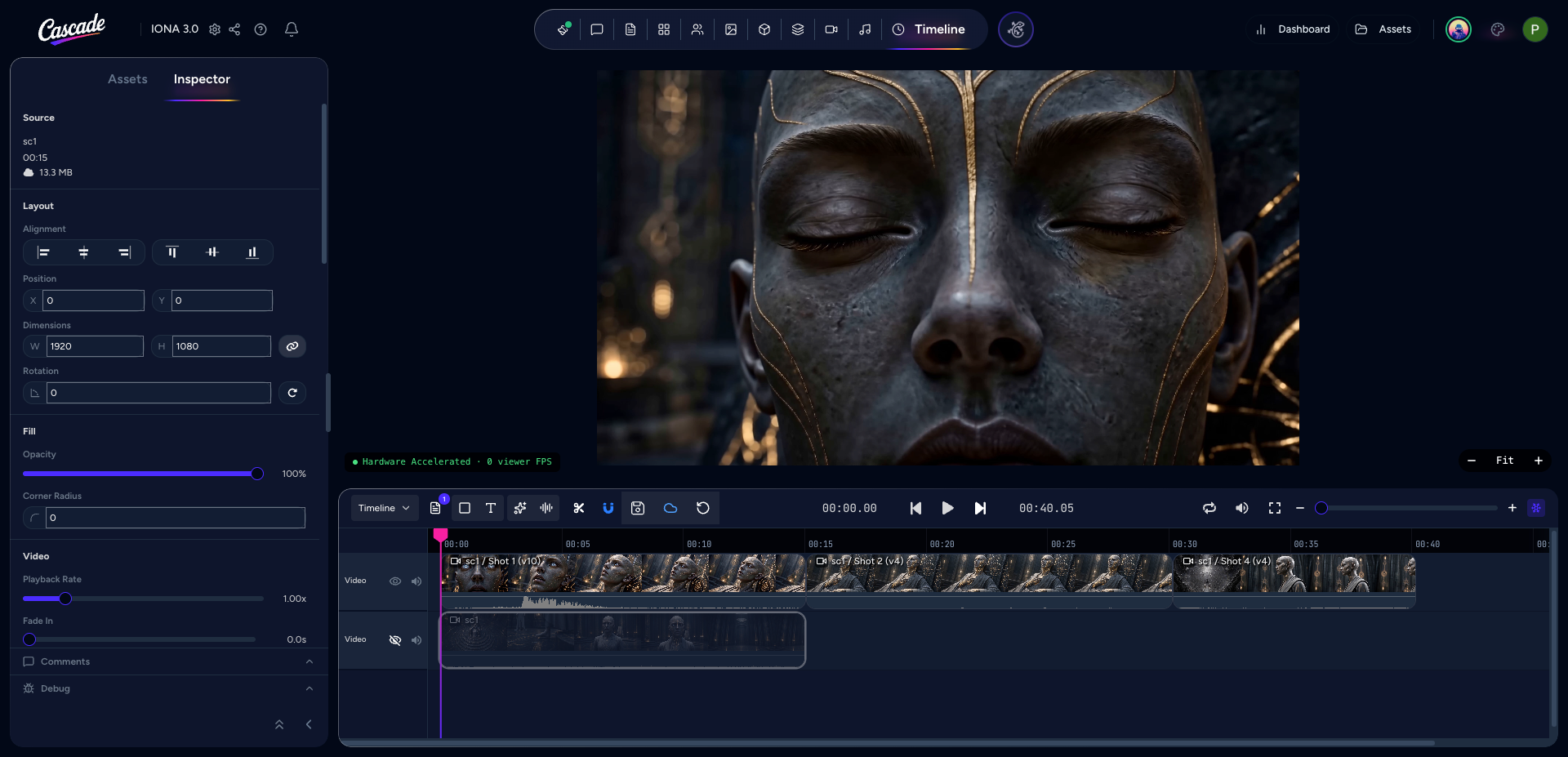
K: The script comes first, and that part stays traditional. I build it outside Cascade the way I always have. Where it got interesting was handing that material over. I was genuinely impressed by how intelligently Cascade read it and broke down the assets: characters, environments, and props, all versioned so I could move back and forth without losing track of anything. That is the part that usually falls apart with AI work. Here it held. It is a proper film pre-production pipeline that does not break.
From there it became an organized march. Scenes broken down, shots distributed, and approval gates that let me actually advance. I could lock a stage, move forward, and trust that continuity three steps back was intact. For someone trying to build a complex, original world, that structure was the whole game.
One thing won me over completely. My character carries intricate tattooing and costume detail, exactly the kind of thing that normally drifts shot to shot with AI, where you spend half your energy fighting to keep a face or a marking consistent. Cascade held it. The details stayed true across the breakdown without me policing them.
And that is when the feeling shifted. At a certain point I stopped sensing that I was straining to hold the whole thing together in my head, and started feeling like a kid in a sandbox with all his toys lined up for the next performance. That is the unlock. When the pipeline carries the continuity, you get to spend your attention on the storytelling. Then the art board is where it gets generative, where I could build cuts for each scene in chunks. The canvas is fast and intuitive enough that it keeps up with the thinking. That is the direction to adopt, and I love it.
K: Generating real options. Multiple takes on a shot or a scene, fast. That was the biggest win, and it sounds modest until you have lived without it. Before, every shot was a commitment. An idea was expensive to visualize, so you locked your choice early, usually based on what you could describe rather than what you could see. You rarely got to ask what if it were framed lower, or colder, or held a beat longer, because testing that meant time you did not have.
Now I can brainstorm by generating. I throw several versions of a shot onto the canvas and let my eye decide instead of deciding in my head and hoping. It turns directing into something closer to sketching, where you find the shot by trying it. The thinking happens on the canvas, in front of you, at a speed that keeps pace with the idea. That was virtually impossible before, and it is the thing I would struggle to give up now.
K: The surprise came early, in visual development. I had picked my models and the style I was after, fed it the script, and the first pass came back genuinely in line with what I had written. That stopped me. Normally finding a distinct look is a noodling process. You generate and discard and generate again, chasing a feeling for a long time before anything resonates. Here the world showed up close to what was in my head on the early attempts. Getting to a look that felt like mine that quickly was not what I expected.
The other surprise was when the pipeline brings in sound. SFX, VO, music, and scoring all arrive at the right point in the process, and the editing and scoring tools are genuinely sharp. Sound is so often the afterthought in this kind of work. Having it integrated at the right moment meant the teaser could be built as a complete piece rather than a silent render I would have to go rescue later.
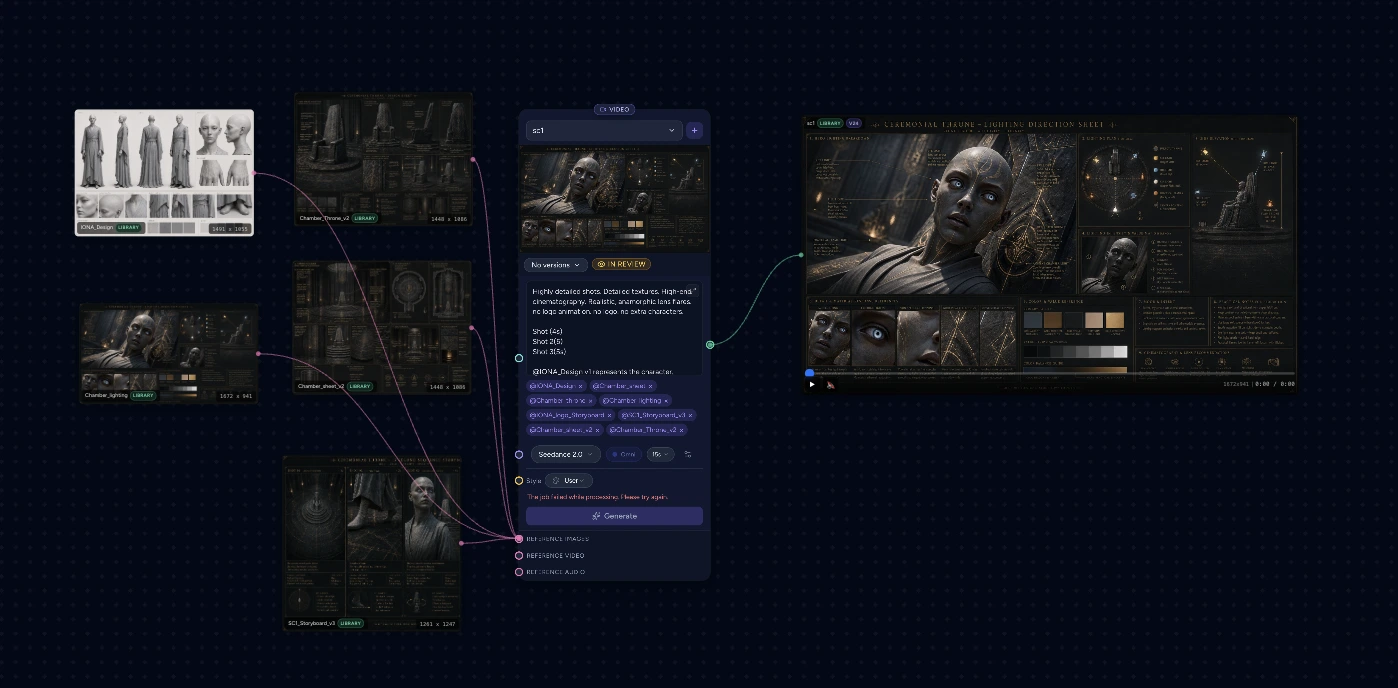
K: GPT Image 2 for all visualization, including design, boards, and callouts. Seedance 2.0 Pro for every shot. Suno for music.
GPT Image 2 is, by a distance, the strongest pre-production visualization tool out there right now. The thing that matters at the design stage is trust. It barely hallucinates, so what comes back is usable. For holding a consistent vision across boards and callouts, especially with a character carrying as much fine detail as mine, that reliability is everything.
Seedance 2.0 Pro handled the shots. It is powerful, and the real reason I leaned on it is how it takes direction. It is intuitive in a way that feels like working with something rather than wrestling it. You give it intent and it understands. For motion that had to carry real emotion in IONA, that responsiveness made the difference. Worth noting that I built this on 2.0 Pro before 2.5 was even out, and it already gave me everything the teaser needed.
Together they were the perfect combination for bringing IONA to life. GPT Image 2 to find and lock the world, Seedance 2.0 Pro to set it in motion, and Suno to give it a pulse.
K: Honestly, I am still in it, so ask me again in a month. Within the teaser, the hardest thing to get right was the acting. Not the environments and not the architecture of the place. The entire teaser rests on her: the confusion, the pull of the call, the wrongness of a person who should be afraid and is not. Believable human behavior is the frontier these models still have not fully cracked. You can nail every other frame, and if her presence does not read as a real person, there is nothing underneath the spectacle.
Looking ahead to the full short, the challenge I am wrestling with now is the transformation, a sequence built almost entirely from light and energy. That is a different demand on the models. It asks them to invent rather than reproduce. Generating a convincing human is becoming routine. Getting abstract light and geometry to carry genuine emotion is the harder, more interesting problem, and that is the one I am chasing.
K: Lots. And lots. Broken shots, broken acting, and artifacts are still the hard reality of working with AI, and anyone who tells you otherwise is not showing you their discard pile. I have been redoing every scene from day one. That is the nature of the beast.
Here is what changed. The churn is now a power. You keep trying until the frame matches what you envisioned, and the cost of another attempt is low enough that you actually can. I could not have said that a year ago. Back then the same process was painstaking and genuinely soul-crushing, because every iteration cost so much that failure felt terminal. Now you feel the iteration in a positive way. The redo is where the work gets better.
The biggest lesson is communication. How you talk to these tools is the whole game. Precision of intent is what separates a usable result from another artifact-ridden throwaway. The second lesson follows from it: think ahead and plan a little more deliberately. The clearer you are before you generate, the less you throw away after. The tool rewards directors who actually know what they want.
K: You know it is finished when it plays clean and the flow does not break, when nothing pulls you out. Getting there means becoming your own harshest viewer and running the same checklist on every pass. Did the face change between shots? Did anything in the clothes shift? Did a finger morph, did the environment drift, did the source sound jump? Would a viewer catch any of it? You scrutinize it frame by frame, hunting for the small betrayals that snap the illusion.
Narratively, I am always watching the face, the mannerisms, and the body language. That is where it lives or dies. Finished is when all of it lines up with my own standard, and I will admit that standard is personal. It varies from one director to the next. You feel when it clears your bar. Honestly, finished is a moving target with this work. 4K just landed for Seedance 2.0 this week, and I can already imagine how much that sharpens the whole process, so I hold it loosely. The teaser is finished when it earns its cut to title without a single thing breaking the spell.
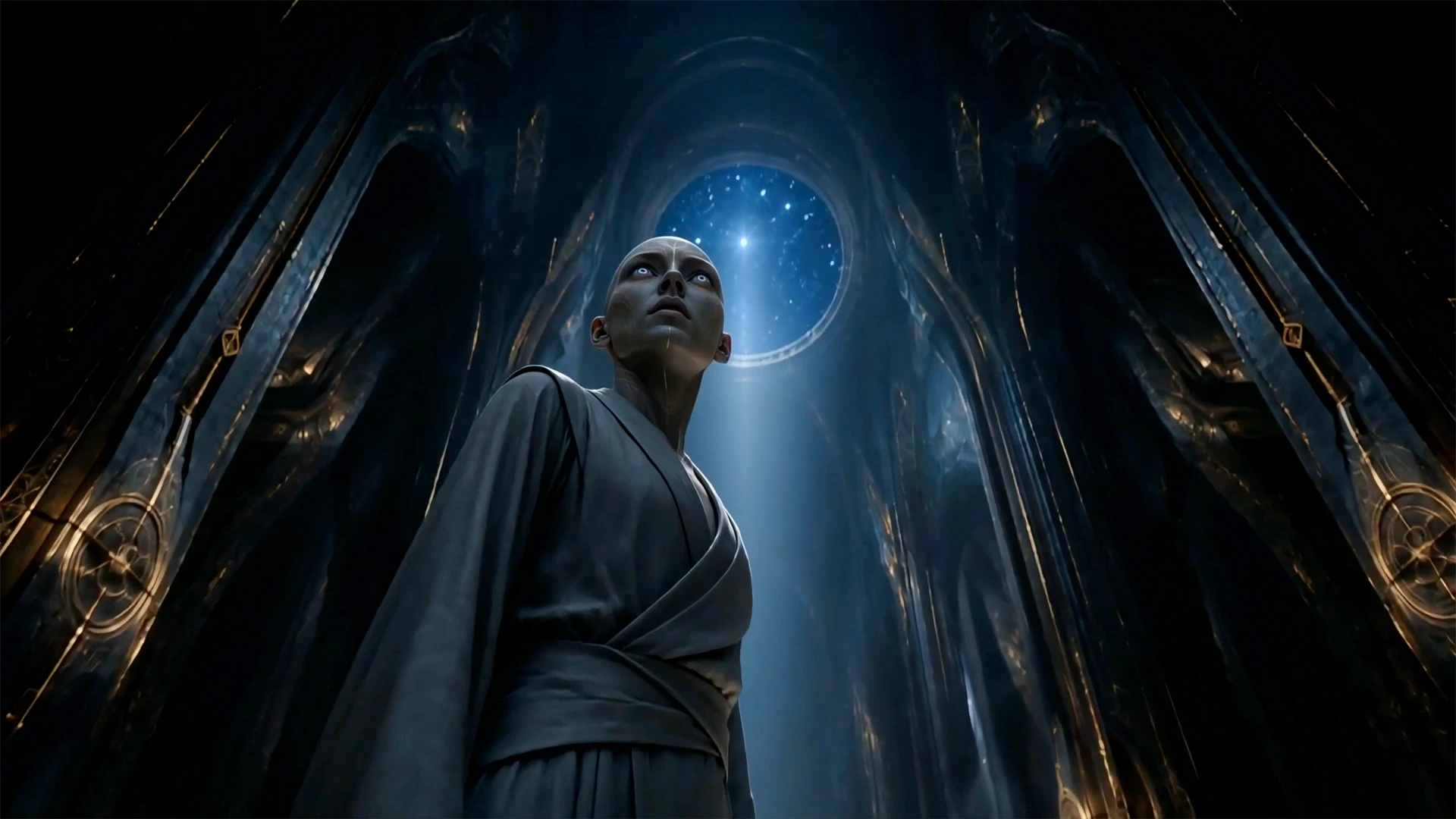
K: That IONA reads as genuine. When she explores the space, there is a real person in it: the curiosity, the unease, the sense of someone actually inhabiting a moment rather than being puppeted through it. That was the exact thing I was most afraid of not landing. It was the one element I told myself I had to get right, and watching her come across as human is the part that makes me feel I actually pulled it off.
I am also quietly proud of the opening shot. It is two fifteen-second generations stitched into one continuous move, and you do not feel the seam. It plays as a single unbroken breath into this world. Getting that to flow invisibly, given everything that can break between two clips, is the kind of small technical win nobody is supposed to notice. That is exactly why it is satisfying.
K: With the tools I have right now, honestly not much, which is a sign of how far the workflow has come. Two things stand out.
First, performance. If I had a budget, I would shoot reference footage. Hire an actor, record each shot as a performance, and use that to drive the generation. Acting is still the hardest thing to coax out of these models, and real human reference would let me direct the performance rather than chase it prompt by prompt. That is the version of IONA I would love to make.
Second, sound. Music and SFX are still my pain-point. I am evolving those workflows, and they are not yet where my visual process is. On an actual production I would bring in sound designers and composers and collaborate properly, and treat my own sound work for what it really is: a way to sell the pitch and the idea. Knowing the limits of your own lane is part of the job.
K: Slow down before you rush in. Take a moment to absorb how advanced and considered the thing actually is. It is built by industry pros who have clearly thought about the whole pipeline. Respect that and you will use it better.
The real advice is this. Come in knowing what you want to say. The platform will hold your world together and move at the speed of your ideas, and it amplifies clarity rather than replacing it. The creators who get the most out of it are the ones who can communicate intent precisely and plan a step ahead. Bring a point of view. The tool rewards directors who actually know what they are after, and it leaves the ones hoping it will decide for them with very little.
K: The goal is to start realizing some of the feature and series concepts I have been holding onto. IONA is the first door, the universe I most want to keep building toward, and it opens into a slate. I want to push into horror, sci-fi, and dark fantasy, the territory where these tools and my instincts meet most naturally.
The one I am quietly most excited about is an animated family feature with real heart at its core. After all the dread and celestial scale, there is something I need to prove to myself there too. The same toolkit that can build a floating facility in deep space can also carry warmth, tenderness, and the stuff that makes a kid and a parent feel something in the same frame. If I can do both, that is the whole range of what I came here to do.
K: Only that this is the most exciting time I have known to be a storyteller, in a while! A year ago the process was soul-crushing. Now it feels like a sandbox. The tools have almost caught up to the ambition, and platforms like Cascade are why. IONA arrived at the right moment, and I think this is just the beginning. I cannot wait to keep building.