
.webp)
Hate or Dance is a 6-minute conceptual fantasy short built on two warring factions, drawing on Ancient Egyptian and Ghanaian kente aesthetics. Mid-film they transform into dancers, pivoting from brutal warfare to a soft, Cascade-branded dance sequence scored by children's voices, Sanskrit bija mantras, and sacred techno.
It's the founding film of Mugen Dream Forge, Jonathan Carène anthology multiverse IP, and doubles as both a technical showcase and a quiet dialogue between creator and creation. What began as a branded action piece grew into an 11-character, 5-duel fantasy epic, powered by Nano Banana Pro, Seedance 2.0, Suno v5.5, and ElevenLabs, with Cascade's Playground and Video Playground enabling parallel generation across scenes without breaking creative momentum.
JC: Hate or Dance is a conceptual fantasy short film, 6 minutes, 11 characters, two factions built for war who are transformed into dancers. The film is built on a single structural idea: contrast as the subject itself. Two chromatic registers that never contaminate each other. Two musical worlds that couldn't be more different. The same characters in two completely opposite states of being. It's fantasy, but the ending refuses the genre's conventions. It's also the founding film of Mugen Dream Forge, an anthology multiverse IP where each film is a self-contained world.
The story is about transformation, bending conventional expectations with an unexpected artistic twist. The genre is hard to define as it sits between warfare, music video and short story, while the purpose is also a technical demonstration through visual immersion. Finally, it's a dialogue between the creation and the creator, sitting close to a 4th wall breach made uniquely possible by AI.
The universe is deliberately multicultural. Two factions drawing from Ancient Egyptian iconography and Ghanaian kente textile tradition, characters representing a wide range of ethnicities and aesthetics. The world of Mugen Dream Forge is designed to be universal and inclusive, rooted in a genuine engagement with cultural diversity rather than aesthetic borrowing.
JC: I started with a simple brief: an action short featuring my character Masayumi using an artefact to stop a battle and reveal the Cascade logo. That brief connected with something I had been wanting to explore for a long time, a full fantasy warfare sequence with precise character design, distinct factions and intentional world-building.
From there the project grew beyond the original scope. The script evolved from a branded action piece into a visual story built entirely around contrast and intention. The music came last and crystallized everything: children's voices opening the transformation, then the bija mantras dropping over a sacred techno pulse. That contrast between innocence and ritual, between lightness and weight, became the emotional spine of the film.

JC: Every element was designed with precision. Narratively, each character is introduced individually, their design establishing identity and creating proximity with the viewer before the action begins, so that every duel carries weight and continuity. Each fight sequence has its own climax and functions as a self-contained mini-story, with realistic, readable movement throughout.
Visually, the pivot is built around Masayumi's intervention, a key structural moment where time stops and a character from a different universe entirely enters the story. Her design signals immediately that something has shifted. The final sequence then had to deliver something precise: softness and contrast, the same characters reimagined through new costume design and immersed in Cascade's branded universe.
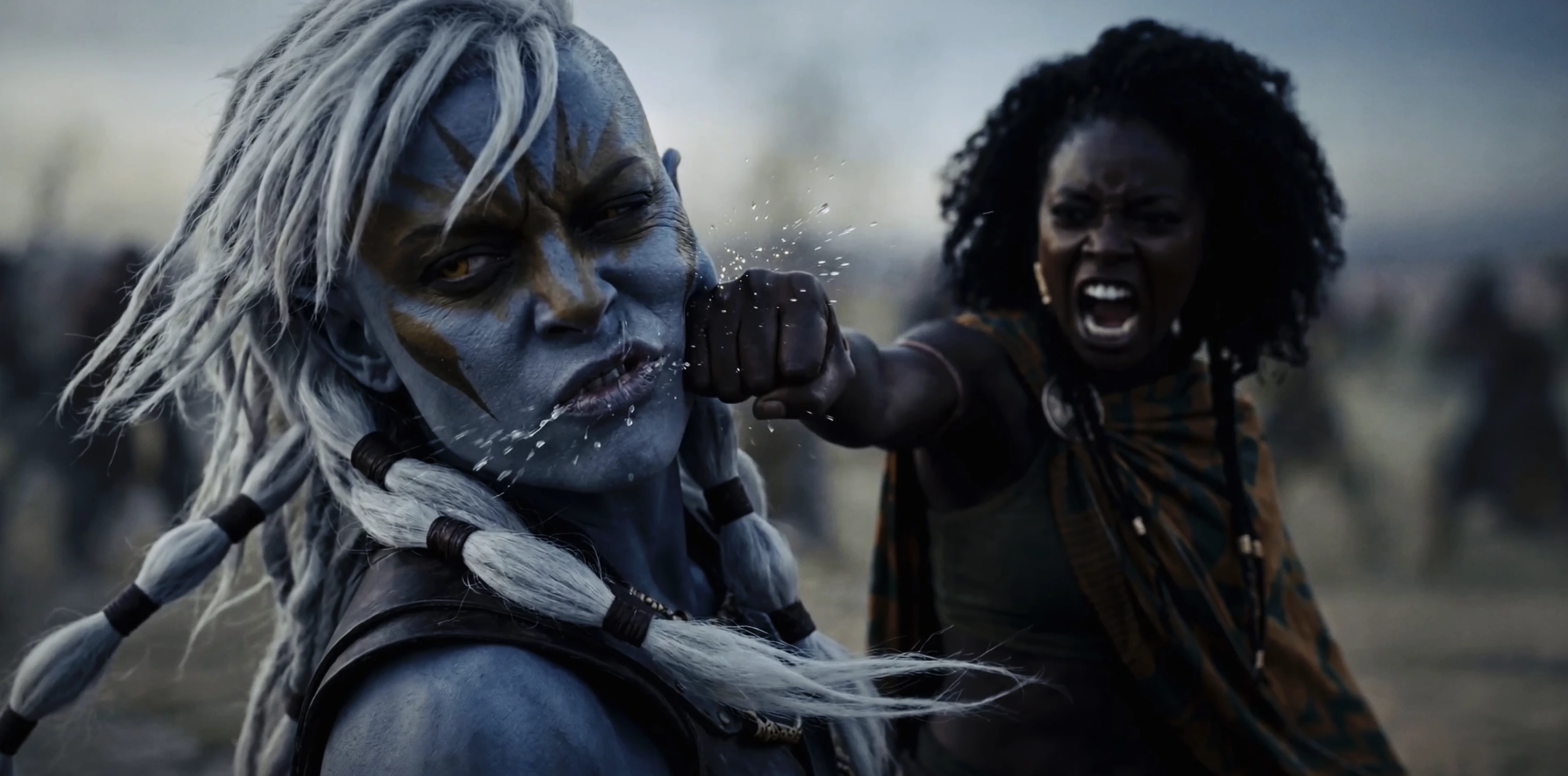
Technically, the one thing that absolutely had to work was the emotional contrast. The battlefield had to feel real, with angry faces, tense bodies, rage and hatred that read immediately and credibly. A coherent background, fluid and genuinely interesting exchanges between characters, the physical weight of conflict. Without that foundation landing convincingly, the transformation would have meant nothing. The harder the hatred, the more the shift matters. Getting that first half right was the hardest thing in the entire production.
JC: Cascade proved incredibly efficient for organising the different reference files across characters, scenes, environments and props, keeping the entire production structured and accessible throughout.
The visual research and design iterations were made possible by Cascade's Playground tab, which offers access to multiple models from the same prompt. That ability to compare outputs, refine direction and maintain a consistent thread across generations was central to how the look of the film was developed.
Where Cascade stood out most in this production was the Video Playground, which allows multiple video generation to be tested, and enables work across multiple scenes simultaneously while staying organised. Concretely, this eliminated the friction caused by waiting on individual results.
JC: When a project reaches this level of density, having all your references organised and instantly callable within prompts, without uploading anything each time, changes everything. Whether continuing a scene from a video reference, maintaining character consistency across shots, or pulling different environmental and prop assets into a new generation, the way Cascade structures production assets feels genuinely calibrated for filmmaking rather than adapted from a general-purpose tool.
That, combined with the ability to generate images and videos across multiple scenes in parallel, keeps the production moving without interruption. And access to the best available models from a single interface, without switching tools or contexts, means the focus stays where it should: on the work.
JC: Yes, the Playground feature launched during production and genuinely changed the way the film was made. The surprise was not just the feature itself, but what it enabled: continuity within the platform.
JC: Image generation: Nano Banana Pro (v1 and v2) as the primary tool, chosen for its prompt adherence, output quality and accuracy, and ability to handle complex cultural references including Egyptian iconography and Ghanaian kente textile without flattening them. GPT Image 2 for complex compositional prompts and as a design alternative. Midjourney 8 for aesthetic research and style exploration only.
Video animation: Seedance 2.0, chosen for motion quality and its ability to handle complex character movement, particularly across the fight sequences.
Music: Suno v5.5, two original compositions built from scratch with detailed prompt architecture and full use of Suno's pro features. The prompt engineering was complex, blending genres that don't naturally coexist and pushing the platform's vocal capabilities in specific directions. Every choice was deliberate.
Voice: ElevenLabs v3. The voiceover was partially performed by myself and then processed through Masayumi's recurring voice profile.
Post-production: DaVinci Resolve and Photoshop.
JC: The battle sequences were the hardest, not because of a single technical problem, but because of the density of what had to work simultaneously. Five individual duels, each functioning as a self-contained mini-story with its own climax, across two visually distinct factions, with 11 characters that had to stay consistent across generations.
The Egyptian faction's blue-grey stone skin and the Kente purple skin warrior were a recurring source of drift. Seedance consistently pulled toward Avatar and Na'vi aesthetics, contaminating the visual register with a reference that belonged to someone else's world and adding a tail. This required redesign and redo of preexisting scenes for global consistency. Every prompt required deliberate architectural choices to hold the faction's identity intact.
Character design consistency was a structural challenge throughout, especially with scenes featuring many characters at once. Because the design was very specific, every detail had to be inside the prompt to ensure consistency.
The backgrounds and environments were equally demanding. The pre-dawn battlefield had to feel physically real: cold grey-blue desaturated light, ground dust behavior that stayed flat and passive at ankle height without spinning or rising, a coherent spatial logic that made each duel feel located in the same world while warriors in the background behave in a believable way, fighting with warriors from the opposite faction. Getting those environmental conditions stable across multiple generations while keeping movement readable was a sustained technical problem.
Camera coherence was another constant pressure. Each duel needed its own cinematic grammar: tight cuts, specific angles, the physical weight of combat reading through the lens, but the camera had to feel consistent with the world. Orbital moves were actively avoided. The camera had to feel grounded, shoulder-mounted, present in the fight rather than circling it.
Physical coherence in the movement itself was the deepest challenge. Fighters had to move with real weight, explosive but credible, never floating, never slipping into the uncanny smoothness or physical nonsense that AI generation can default to. Ground contact, impact absorption, the momentum of bodies in collision, all of it had to be described in terms of physical state and intention rather than choreographic steps, because step-by-step description produced exactly the mechanical stiffness that destroys credibility.
Precise prompt design was a key factor, just as much as the ability to rely on multiple results to check the quality of each prompt and get bits of scenes that could be chopped in post production. Every decision was made alone, in real time, under generation pressure.
JC: The most costly mistake of the entire production was a design drift that went undetected too long. The character descriptions were not precise enough in the early storyboard phase, and by the time the problem became visible across generated scenes, it had propagated through hours of work. Fixing it required more than 12 hours of redesign, regeneration and rebuilding from scratch. It came from not writing the production bible with enough specificity before generation began, and from catching the drift too late. That is a lesson that will inform every future production: lock the design completely, exhaustively, before a single frame is generated. There is no recovery cheaply from a drift that has already spread.
The Avatar and Na'vi drift was a separate discovery, triggered by specific skin tone choices on two characters: Pearl from the Egyptian faction and Violett from the Kente faction. Once identified it could be managed architecturally, but scenes already generated with contaminated visual registers had to be redone. The model's tendency to reach for recognisable cinematic references when given ambiguous input is a fundamental constraint that has to be anticipated at the design stage, not corrected in production.
Character design itself produced two categories of failure worth naming explicitly. The first is props and weapons: the wrist-mounted arrow launcher on Musashi was abandoned after exhausting every available approach. Multiple visual references, different prompt architectures, variations in description, none of it produced a model that recognised the weapon as functional rather than decorative. The second is structural design elements that are simply beyond reliable generation: chains were predictable. The lesson across both cases is the same: anticipate at the design stage what the model can render as a physically coherent object in motion, and avoid building identity-defining elements around things it cannot.
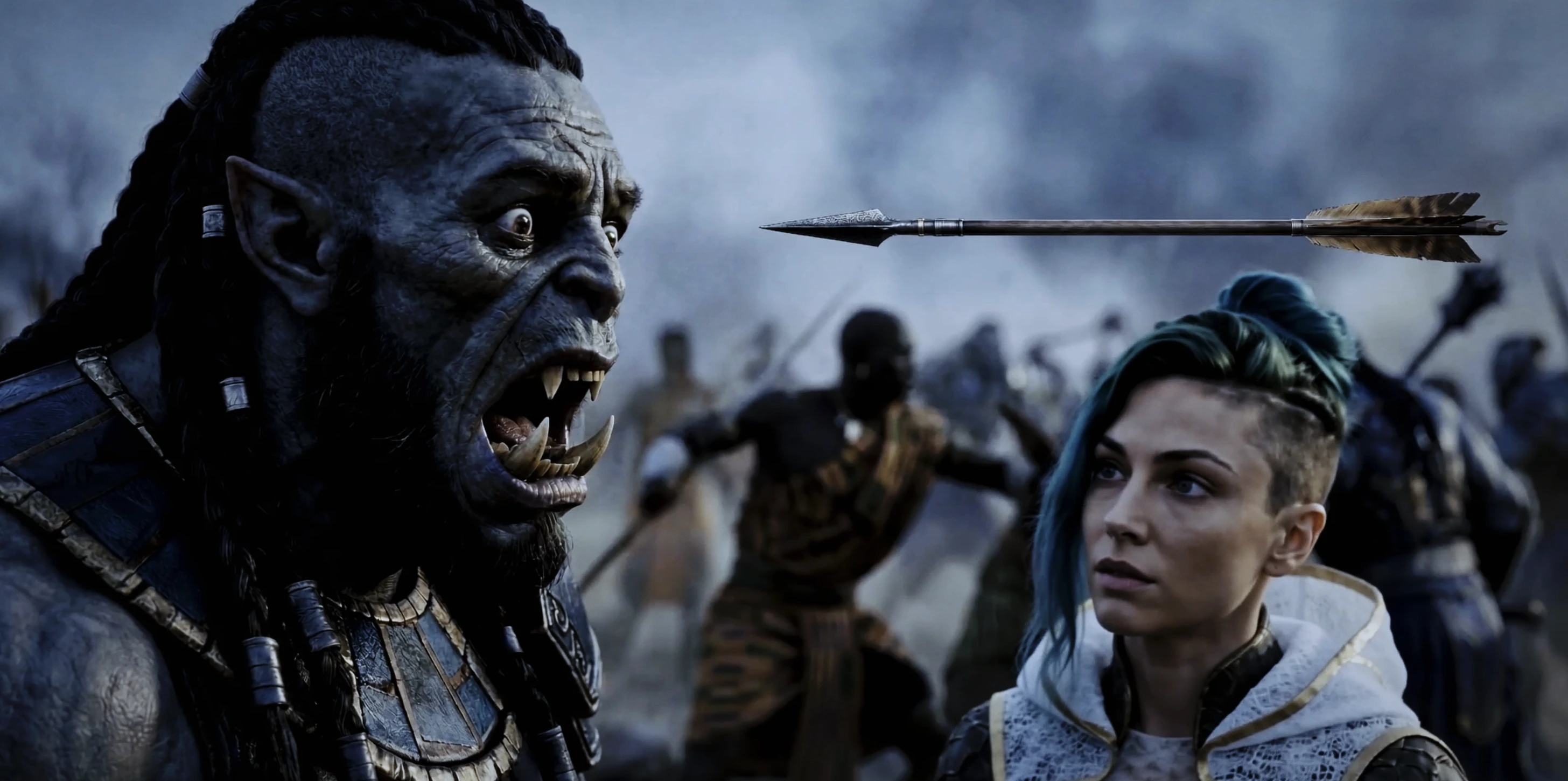
Masayumi's arrival was one of the most complex spatial problems in the film. Her scale relative to the orc, her movement logic near a character built entirely differently, and the removal of the suspended arrow frozen mid-flight, all of it had to hold simultaneously. Getting her presence to feel grounded in a space she was never designed to share with those characters required sustained iteration.
The dance sequences in smoke were the final major challenge. The smoke environment architecture had to be rebuilt from zero before any dance generation could work reliably. Generic dance instruction produced generic output. The only thing that worked was triggering the model through cultural state and physical context, giving it a body in a specific situation rather than a body executing named moves. That shift took time to find and cost multiple failed generations before the approach crystallised.
JC: Every character had their scene, their moment, their emotion. Each one was shown and given space to exist fully within the new environment. Once that was complete, it was time to close with Masayumi, the creator figure closing the dance, the loop complete. The color grading and editing work ran progressively in parallel with the generations throughout the production. Once all scenes were assembled, some were regenerated to fix small remaining issues, then came the reframing, the color grade, the mix, the camera shake and impact effects, the subtitles, and finally the upscaled render out of DaVinci. When that render was done and nothing felt wrong anymore, it was finished.
JC: I am proud of seeing this titanic work through to completion. I am proud of having solved every technical challenge the production threw at me. I am very proud of the design work across the entire production. I am proud of having built a singular, original and genuinely artistic universe. And I am proud of the music, even while being clear-eyed about it: the choices for the dance section, children's voices, Sanskrit mantras, didgeridoo, Celtic harp and techno, produce something deeply personal that audiences can sometimes struggle to connect with. I knew that going in.

The Sanskrit mantra in the drop was chosen with care. Svapna Siddhi, Aim Shrim Hrim, Vam Yam Aim Ananda Shakti are all Vedic bija mantras with verified positive associations around creativity, joy and accomplishment. Svapna Siddhi translates as "the accomplished dream," which is also what Masayume means in Japanese. That loop was intentional.
The French lyrics are personal. "Une étincelle devient une idée, et l'univers se diffuse en lumière, une intention voit le jour, rêve éphémère, nuage d'amour." A spark becomes an idea, and the universe spreads as light, an intention comes to life, a fleeting dream, cloud of love. It reads as a description of the creative process itself, of how something goes from nothing to existing. It is directly connected to who I am, to Masayume Studio and to the act of making. In a film about transformation, it felt right that the music carrying the shift would also be a quiet statement about why I create.
JC: Everything, starting with spending far more time in pre-production. I would also establish conventional cinematic narrative structure from the beginning, so that the storytelling gives the audience clear codes to hold onto. More broadly, I would make the work for the audience rather than as a personal artistic statement, which is what this was.
I sense that what people expect from AI film is not formal innovation in narrative proposition. They want recognizable structure. Without it, no one follows. For me this work is a painting. The audience feedback tells me that expectations vary enormously, that projections onto the work vary enormously, and that it generates more frustration than pleasure for many viewers. A simpler, more conventional narrative arc would have served communication better.
People often say AI cannot produce singular artistic work. For me this film is proof of the opposite. But the audience does not seem to want this type of work, or at least not yet. It was an assumed risk. I am glad that some people understood my artistic intention. We will see what its festival journey brings.
JC: Cascade does not offer a singular workflow, instead a wide range of possibilities and approaches. Start with small projects to explore and get familiar with what it can do and find out the most convenient way of using it for each individual. Take time with writing and asset generation, because the quality of video outputs depends enormously on the quality of the reference images going in. And understand how Cascade structures and facilitates video production so you perform actions in the right order and keep the whole process fluid. The platform is built for filmmaking — learn its logic before you push its limits.
JC: Several projects in parallel. I am finishing Tama and the Orbs, a 3D animation IP in its own right. I am developing a 2D anime IP. I am completing the final details on Otsukare Gasa, an experimental immersive hyperrealism short. And I am developing the next Mugen Dream Forge film, likely set in a world of ninjas and yokai — but narrative clarity is a priority this time. It has to be immediately legible to the viewer that this is an anthology format in the spirit of Love Death and Robots or Black Mirror, not a continuous universe. That framing has to be built in from the start.